Delivery job openings in 2026: pay starting at $15–$25+ per hour, flexible schedules, and no experience required for many roles!
Delivery Jobs Hiring Now in 2026: Find Your Role and Start Earning $15–$25+ Per Hour
You've seen the numbers — delivery jobs are paying well and hiring constantly in 2026. Now it's time to see exactly what's out there: which companies are posting roles, what those jobs actually pay, what the work looks like day to day, and how to get your application in front of the right people.
Delivery jobs are hiring now — see open positions
Browse real openings from Amazon, UPS, FedEx, DoorDash, and more.
Delivery work has quietly become one of the most accessible and steady job categories in the country. Large logistics companies, gig platforms, and local courier services are all competing for drivers and couriers right now, which means more leverage for job seekers than there was a few years ago.
Why delivery jobs are worth a serious look in 2026
The pay has improved. Starting wages that once hovered around minimum wage now routinely open at $15–$18 per hour for entry-level roles, and experienced drivers at companies like UPS, FedEx, or Amazon Logistics can clear $25+ per hour before tips or bonuses. Gig platforms like DoorDash, Uber Eats, and Instacart let you set your own hours, which works well if you're juggling another job or family commitments.
Beyond pay, the barrier to entry is low. Most roles require a valid driver's license, a clean enough driving record, and the physical ability to lift packages (usually up to 50 lbs). No degree, no certification, no years of experience needed for the majority of openings.
What types of delivery jobs are available right now
- Last-mile package delivery (Amazon, UPS, FedEx, USPS)
- Food and grocery delivery (DoorDash, Uber Eats, Instacart, Shipt)
- Freight and LTL driving (requires CDL for heavier loads)
- Medical and pharmaceutical courier work
- Local same-day delivery for retailers and florists
- Alcohol and specialty delivery (licensing varies by state)
Each category has its own pay structure, schedule expectations, and physical demands — so it's worth thinking about which fits your situation before you apply.
Pay breakdown by delivery job type
Pay varies a lot depending on the employer, your location, and the type of delivery work. Here's a realistic look at what workers are earning in 2026:
- Entry-level courier/package delivery: $15–$18 per hour
- Amazon Delivery Service Partner (DSP) driver: $18–$22 per hour plus benefits
- UPS and FedEx ground driver: $20–$28 per hour (union roles at UPS can go higher)
- DoorDash and Uber Eats: earnings vary widely; many drivers report $15–$22 per hour after expenses in busy markets
- Instacart and Shipt shoppers: $16–$24 per hour depending on order volume and tips
- Medical courier: $17–$23 per hour
- CDL freight driver: $25–$40+ per hour depending on route and cargo
Tips make a meaningful difference in food delivery and grocery roles. Drivers in dense urban markets or high-income suburbs consistently report higher totals.
Benefits you can expect from employer-based delivery roles
Gig work typically comes without benefits, which is worth factoring into your comparison. But employer-based roles at companies like UPS, Amazon, and FedEx often include:
- Health, dental, and vision insurance (many plans extend to family members)
- Paid time off, sick leave, and holiday pay
- Retirement savings plans with employer contributions (UPS Teamsters members, for example, have strong pension coverage)
- Tuition assistance programs for workers who want to pursue further education
- Employee assistance programs covering mental health, financial counseling, and legal advice
- Paid training periods so you're earning from day one
If benefits matter to you, employer-based roles are the stronger choice. If flexibility is the priority, gig platforms win on that front.
What the work actually looks like
Most package delivery roles start early. A typical shift at a logistics hub begins between 6 and 9 a.m. You'll load your vehicle, follow a route optimized by the company's software, and make anywhere from 80 to 200 stops depending on the route density and package size. It's physical work: lots of getting in and out of a van, lifting boxes, and navigating neighborhoods in all weather conditions.
Food delivery is more stop-and-go. You'll accept orders through an app, pick up from restaurants or stores, and drop off to customers. Peak earnings come during lunch and dinner rushes, and on weekends. Many drivers do this alongside another job because the hours are genuinely flexible.
Medical courier work is quieter and more structured. Routes are often pre-planned, packages are smaller and lighter, and the job carries more responsibility around handling and timing. It's a good fit for detail-oriented people who prefer a predictable day.
Requirements most employers ask for
- Valid U.S. driver's license (CDL required for freight/heavy routes)
- Clean driving record (specific requirements vary by company; most want no major violations in the past 3–5 years)
- Ability to lift 50 lbs repeatedly
- Smartphone with data plan (required for gig apps; many employer roles also use mobile routing apps)
- Background check clearance
- Reliable transportation for gig roles (your own vehicle, plus insurance that covers delivery work)
Some companies, like Amazon DSP, provide the delivery van. Others, particularly gig platforms, require you to use your own car. If you're going the gig route, check whether your personal auto insurance covers commercial delivery activity — many standard policies don't, and you may need a rider.
Delivery jobs are hiring now — see open positions
Browse real openings from Amazon, UPS, FedEx, DoorDash, and more.
How to apply for delivery jobs: the basic process
Most delivery employers, from large logistics companies to gig apps, handle applications online. The steps below cover what to expect across the board.
- Search for open roles: Use the employer's careers page or a job board to find openings near you. Filter by job type, schedule, and pay range to narrow down the list before you start applying.
- Complete the online application: Fill in your contact details, work history, and driving information. Upload your resume if the system allows it. Double-check that your address and license details are accurate before submitting.
- Submit to a background and MVR check: Nearly all delivery employers run a background check and a motor vehicle record check. This step usually takes a few days to a week. You'll typically receive an email with a link to authorize the check.
- Interview or onboarding call: Some employers, particularly larger ones like UPS and FedEx, will schedule a brief interview or orientation call. Others, like gig platforms, skip this step and move straight to approval once checks clear.
- Complete training and get started: Once approved, you'll go through a short training period covering safety procedures, app use, and route expectations. Many employers pay for this time. After that, you're ready to work.
Response times vary by employer. Gig platforms can approve you within a week. Larger logistics companies may take 2–4 weeks from application to first shift, especially if union paperwork or a physical exam is involved.
Tips to get hired faster in delivery work
Getting a delivery job is relatively straightforward, but a few things will help you stand out and avoid common delays.
- Check your driving record before you apply. You can request a copy from your state DMV. Companies run motor vehicle record checks, and knowing what's on yours lets you address anything upfront rather than losing an offer after the fact.
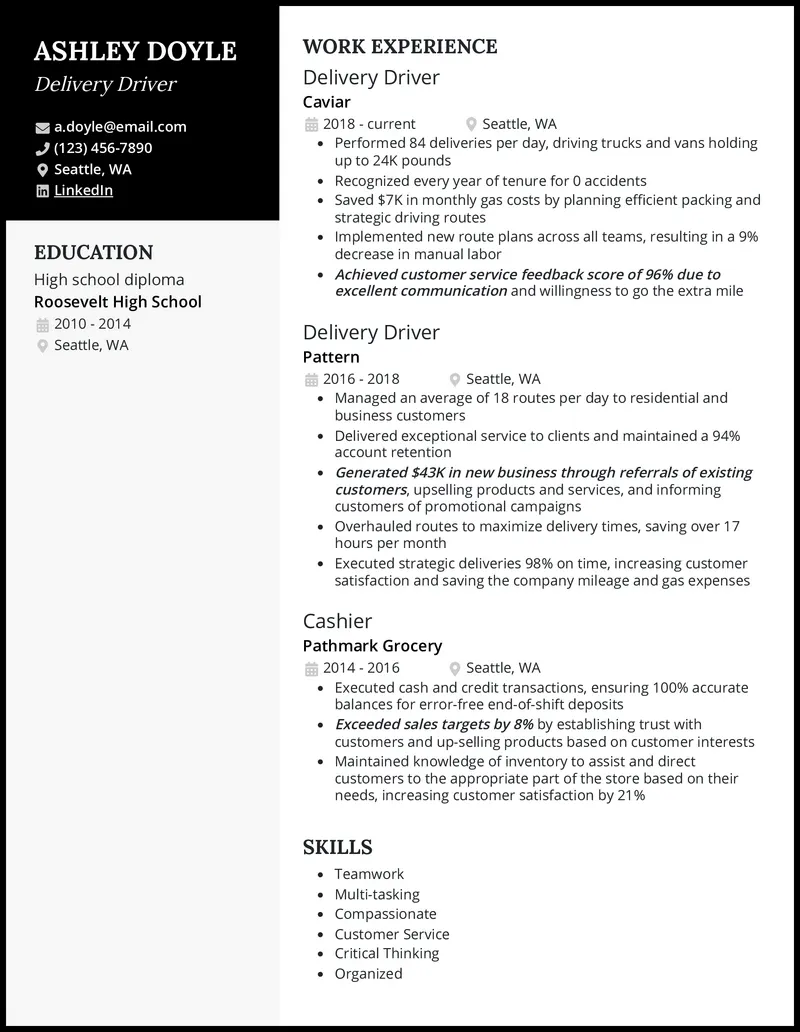
- Tailor your resume to the role. Even a short work history can look strong if you highlight relevant experience: prior driving roles, physical labor, customer-facing work, or time managing your own schedule as a contractor.
- Apply to multiple companies at once. Logistics hiring moves fast, but it can also stall unexpectedly. Having applications in at Amazon, UPS, FedEx, and a couple of local courier companies at the same time improves your odds and your timeline.
- Be specific about your availability. Many delivery employers, especially those with early-morning or weekend routes, want to see that you can commit to their schedule. If you're flexible, say so clearly.
- For gig platforms, get set up quickly. DoorDash, Uber Eats, and Instacart process applications mostly online. Once approved, you can start earning within days. The main bottleneck is the background check, which typically takes 3–7 business days.
- Ask about route types during the interview. Residential routes, commercial routes, and rural routes are very different experiences. Knowing what you're signing up for helps you decide, and asking the question shows you've thought it through.
- Understand your vehicle situation. If the job requires your own car, factor in fuel, maintenance, and insurance costs when comparing pay rates across employers.
- Follow up after applying. A brief, professional email reiterating your interest a week after applying is perfectly appropriate and can bump your application in a recruiter's queue.
Looking for other types of flexible work?
Warehouse, retail, and logistics roles are also hiring in 2026 with competitive pay and benefits.
Warehouse Jobs Hiring Now
Physical work, steady hours, and strong pay — warehouse roles are another solid option worth exploring.