LinkedIn 360Brew Algorithm 2026: Rank Higher in Recruiter Search
Learn how LinkedIn's 360Brew AI algorithm works in 2026 and get actionable tactics to rank higher in recruiter search and get found for your next job.
LinkedIn 360Brew algorithm 2026: rank higher in recruiter search
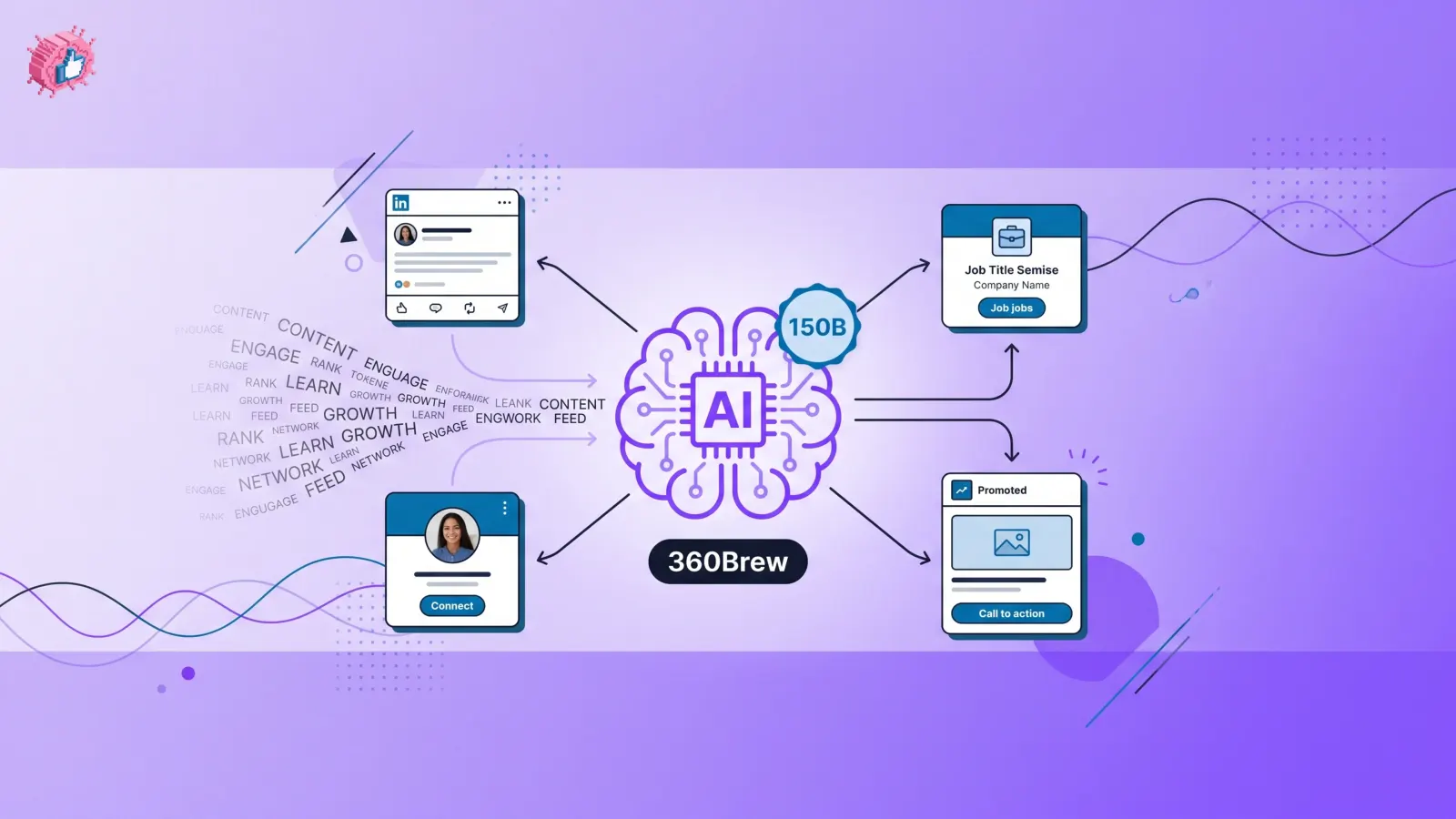
If you've been applying to jobs on LinkedIn and hearing nothing back, the problem probably isn't your experience. It's your visibility. In 2026, LinkedIn's ranking engine underwent its most fundamental redesign in over a decade, replacing thousands of separate recommendation systems with a single 150-billion-parameter AI model called 360Brew. This isn't a tweak. It's an entirely different kind of machine, and the tactics that worked in 2024 now actively hurt your chances.
This article is for active and passive job seekers who want to understand how 360Brew actually works, then immediately do something about it. You'll get a plain-English breakdown of the algorithm, a clear list of what's dead, and a step-by-step optimization workflow you can start today. Whether you're actively job hunting or simply want recruiters to find you before a role is ever posted publicly, this is the playbook.
The upfront verdict: profile semantic coherence, early engagement velocity, and consistent topic authority are the three levers that matter most in 2026. Everything else is noise.
LinkedIn's 360Brew algorithm at a glance
| Factor | Old algorithm (pre-2026) | 360Brew (2026) |
|---|---|---|
| Core model type | Thousands of separate feature-engineered systems | Single decoder-only foundation model (~150B parameters) |
| Graph type | Social graph (who you know) | Interest graph (what you're about) |
| Keyword logic | Keyword frequency / keyword stuffing worked | Semantic understanding reads meaning, not just terms |
| Engagement signals | Likes, comments, reactions counted roughly equally | Saves (5x), comments (2x) >> likes |
| Profile role | Static data source for recruiter filters | Active ranking input read for credibility signals |
| Engagement pods | Marginally effective | Detected, ignored, and can trigger shadow bans |
| Content reach timing | Gradual rollout over days | ~70% of reach decided in the first 60-90 minutes |
| Hiring assistant integration | None | LinkedIn's AI Hiring Assistant runs automated profile scans |
What 360Brew actually is (and why it changes your job search)
360Brew is LinkedIn's unified, decoder-only foundation model for personalized ranking and recommendation. It was detailed in a research paper submitted to arXiv on January 27, 2025, by Hamed Firooz and LinkedIn's Foundation AI Technologies (FAIT) team. LinkedIn publicly confirmed its deployment in the feed on March 12, 2026, via the LinkedIn Engineering Blog post "Engineering the next generation of LinkedIn's Feed."
The key word in that name is foundation model. Instead of running one algorithm for your feed, another for job recommendations, another for connection suggestions, and yet another for ads, LinkedIn now runs a single model across all of them. It's architecturally closer to ChatGPT than to the rule-based ranking stack LinkedIn used for the previous decade. That means it doesn't just match keywords. It reads your profile and infers what you're actually about.
The shift from social graph to interest graph
The old LinkedIn algorithm was social graph-driven: it showed you content and candidates based on who was connected to whom. Network size was a genuine growth lever. The 360Brew era is interest graph-driven: who posted something matters far less than what it's about. A post from a stranger demonstrating deep expertise in supply chain logistics can now outrank a post from a first-degree connection in your feed. For job seekers, this is enormously important. You don't need a massive network to get found. You need a coherent signal.
The quiet hiring problem
Over 90% of recruiters use LinkedIn as their primary sourcing tool, and many hiring managers shortlist candidates through LinkedIn Recruiter searches before a role is ever publicly listed, a practice known as quiet hiring. LinkedIn's new AI Hiring Assistant accelerates this further: it runs dozens of automated searches across the platform to surface candidates, evaluating keyword match, skills alignment, activity signals, and profile completeness. Early adopters of the Hiring Assistant report reviewing 81% fewer profiles to find qualified matches, and seeing 66% higher InMail acceptance rates. If your profile doesn't rank in those automated searches, you don't exist to those recruiters. In 2026, seven people are hired every single minute on LinkedIn, but organic reach for recruiters and company pages has dropped by over 60%, meaning fewer eyeballs see fewer things. The algorithm decides almost everything.
How the algorithm ranks your profile and content
The three-gate distribution process
Every piece of content you publish passes through three sequential gates:
- Quality filter. 360Brew classifies your post before any human sees it. Content that resembles templated AI output, engagement-farming prompts ("Comment YES if you agree!"), or spam patterns is throttled immediately and never reaches a real test audience.
- 60-90 minute velocity test. If your post passes the quality filter, it gets shown to a small seed audience. Engagement speed and type in this window determine whether the algorithm expands distribution.
- Expanded distribution. Posts that survive gate two get pushed to a broader audience. Here's the critical stat: ~70% of a post's total reach is decided in the first 90 minutes.
This means your posting time, your opening line, and your ability to generate real comments quickly are far more important than posting frequency.
Profile as a ranking input, not just a data source
This is the biggest shift most job seekers miss. Your profile isn't just a form that filters fill in. 360Brew reads your headline, About section, experience, and posting history as a credibility signal before deciding how to surface you in recruiter searches and how to distribute your content. A thin, inconsistent, or keyword-stuffed profile now actively suppresses your reach.
The algorithm evaluates semantic coherence across all profile sections. Your headline, About, job descriptions, skills endorsements, and recent posts need to collectively tell a single coherent professional story. If your headline says "Marketing Leader" but your experience describes logistics roles and your recent posts are about fitness, 360Brew reads that as fragmented and ranks you lower in every relevant search.
Engagement quality beats engagement volume
- Saves carry 5x the algorithmic weight of a like
- Comments carry 2x the weight of a like
- Three thoughtful comments beat thirty likes
- DMs and shares are weighted as high-intent active engagement
Passive scrollers who double-tap do almost nothing for your reach. Readers who save your post for later and leave a substantive comment drive the algorithm to push your content wider.
What 360Brew killed: stop doing these things
Engagement pods are dead
LinkedIn's VP of Product confirmed in 2026 that engagement pods are "entirely ineffective" against 360Brew. The algorithm now maps what it calls Coordinated Activity Rings, clusters of accounts that consistently engage with each other in artificial patterns. Lempod, one of the most popular engagement pod tools, was banned from the Chrome Web Store in February 2026. Flagged accounts face 60-to-90-day shadow bans, meaning your content gets quietly suppressed with no warning.
Keyword stuffing backfires
The old algorithm rewarded profiles and posts packed with popular keywords. 360Brew actually understands text semantically, so a headline that reads "Product Manager | Agile | Scrum | SaaS | B2B | GTM | Growth | Strategy | Leadership" is now penalized as spammy, not rewarded. Use natural, specific language that accurately describes your expertise.
Viral format templates are flagged
"10 lessons I learned after being laid off 🧵" posts with numbered lists and emoji ladders were a reliable reach hack in 2023-2024. 360Brew's quality filter is trained to recognize these patterns and throttles them before they reach a real audience.
Optimization tactics: how to rank higher in 2026
Tighten your profile's semantic signal
- Audit for coherence, not completeness. Read your headline, About, and top three experience bullets as if you're a stranger. Do they describe the same person doing the same kind of work? If not, rewrite until they do.
- Write your headline as a value proposition, not a job title list. Instead of "Senior Engineer | Python | AWS | Docker," try "Senior Backend Engineer building scalable data pipelines for fintech startups."
- Use your About section to anchor your niche. One clear paragraph describing what you do, who you do it for, and what makes you effective. 150-200 words, written in first person.
- Match skills to experience. Every skill in your Skills section should be backed up by at least one bullet in your Experience section. Floating skills with no evidence are a coherence penalty.
- Keep your Featured section active. Link to a recent article, a project, or an external portfolio. Stale Featured sections signal inactivity.
Engineer early engagement velocity
- Post when your audience is online. For most professional audiences, Tuesday through Thursday between 7-9 AM and 12-1 PM local time drive the fastest early engagement. Test your own analytics in Creator Mode.
- Write a first line that earns the "See more" click. The first one or two sentences are all most people see before scrolling. Make them specific and surprising, not generic.
- Directly ask two or three specific people to comment within the first 15 minutes of posting. Not a mass tag, a direct, personalized message to someone whose opinion on the topic is genuine.
- Reply to every comment within the first hour. Your own replies count as engagement signals and extend the velocity window.
- Create content worth saving. Posts with a checklist, a framework, a breakdown, or a resource list get saved. Saves carry 5x the weight of a like.
Establish consistent topic authority
- Pick one to two topic clusters and own them. 360Brew builds a content profile for your account over time. If you post about product management one week, leadership the next, and travel the week after, the algorithm has no topic signal to amplify. Consistency in topic builds your interest graph authority.
- Engage deeply with others' content in your niche. Thoughtful, paragraph-length comments on posts from others in your field build your credibility profile and expose your name to their audiences without you publishing a single post.
- Optimize your Open to Work settings. Set your job preferences to specific roles, industries, and locations. The AI Hiring Assistant uses these signals in its candidate matching. Vague or empty preferences lower your match score.
Who should (and shouldn't) prioritize LinkedIn in 2026
LinkedIn in 2026 is the dominant platform for white-collar, knowledge-work, and professional-services hiring at every career stage. It's clearly the right primary platform for:
- Mid-career professionals in tech, finance, marketing, consulting, healthcare administration, and operations
- Passive job seekers who want recruiters to come to them rather than actively applying
- Career changers who need to build a new professional narrative in a visible, searchable space
- Executives and senior leaders where relationships and reputation carry more weight than job board listings
- Anyone in industries where quiet hiring is common, including fintech, SaaS, management consulting, and investment banking
Consider LinkedIn a secondary platform (or deprioritize it) if you are:
- Seeking hourly, trade, or blue-collar roles (Indeed and industry-specific boards will serve you better)
- Applying to entry-level or first-job roles in high-volume industries like retail, hospitality, or food service, where LinkedIn usage by employers is low
- Targeting highly niche technical roles where communities like GitHub, Stack Overflow Jobs, or sector-specific boards have more active hiring managers
- Based in markets where LinkedIn penetration is lower and regional platforms dominate (Xing in Germany, Seek in Australia, Naukri in India)
A real-world optimization workflow (do this this week)
Follow this seven-step sequence to move from invisible to discoverable in recruiter search:
- Run a coherence audit. Open your profile in a private browser window (as others see it). Read your headline, About, and top three experience bullets. Write down the one professional story they collectively tell, or identify where they contradict each other.
- Rewrite your headline. Replace keyword lists with a single value-proposition sentence: [Role] helping [type of employer] achieve [specific outcome].
- Rewrite your About section. 150-200 words, first person, specific niche, one clear paragraph about what you do and for whom.
- Audit your Skills section. Delete any skill not backed up by a bullet in your Experience. Add up to five skills that are central to your target role and do appear in your experience.
- Update your Open to Work preferences. Be specific: job titles (2-3 target titles), location preferences (with remote options if applicable), industries, and job type.
- Publish one piece of original content this week. Pick a topic squarely in your niche. Write 150-250 words with a specific insight, a short list, or a brief framework. Post at peak time, then directly message two colleagues and ask for their genuine take.
- Leave five substantive comments on posts in your niche. Not "Great post!" but a full paragraph adding a perspective, a counterpoint, or a real example. Do this every week. It builds your interest graph credibility faster than posting alone.
Frequently asked questions
Does the 360Brew algorithm affect recruiter search results, or just my feed?
Both. 360Brew is LinkedIn's unified ranking model across the entire platform: feed, job recommendations, connection suggestions, and recruiter search results. When a recruiter uses LinkedIn Recruiter or the new AI Hiring Assistant to search for candidates, 360Brew's profile ranking logic determines who surfaces at the top. Your profile completeness, semantic coherence, skills alignment, and recent activity all feed into that ranking.
How often should I post on LinkedIn to benefit from the algorithm?
Consistency matters more than frequency. Posting two to three times per week with high-quality, topic-focused content outperforms daily posting of generic material. The 360Brew quality filter will throttle low-quality posts regardless of how frequently you publish, and posting off-topic content too often actively dilutes your interest graph authority. One well-crafted, niche-specific post per week is a floor, not a ceiling.
Is the "Open to Work" green banner worth using in 2026?
It depends on your situation. The green banner signals active job seeking to anyone who visits your profile, including your current employer if you're still employed. For active job seekers, it's worth enabling because it directly feeds into LinkedIn's AI Hiring Assistant candidate matching. If you're passively exploring, use the Recruiters only setting (visible only to recruiters using LinkedIn Recruiter) to signal availability without broadcasting it to your network.
Can a small network still rank well in recruiter search after 360Brew?
Yes, and this is one of the biggest shifts the interest graph brings. Because 360Brew now prioritizes topic authority and profile coherence over connection volume, a tightly optimized profile with 200 connections in the right niche can outrank a generic profile with 2,000 connections. Network size is no longer a primary ranking signal. Relevance and coherence are.
What's the fastest way to recover from a shadow ban on LinkedIn?
If you've been using engagement pods or spammy tactics, the most effective approach is to stop all artificial engagement immediately, reduce posting frequency for 30 days, and focus exclusively on genuine, original content in a single topic area. LinkedIn does not officially confirm shadow bans, but the 60-to-90-day suppression window described by researchers typically clears if you demonstrate authentic behavior during that period. Avoid re-installing any banned tools (like Lempod) or joining new pod groups.
Editor's Picks
 News
News 3 Industries Actually Hiring in 2026 (And How to Break In Fast)
Jul 13, 2026
 News
News 584K Jobs Cut in 2026: What's Gone and Where to Pivot Now
Jul 13, 2026
 Interviews
 Your 7-Day Interview Prep Plan: Land the Job in 2026
Jul 13, 2026
 Industries
 AI Is Cutting These Tech Jobs in 2026 — and Creating These New Ones
Jul 13, 2026