Laid Off Despite Record Profits? Here's Your 2026 Tech Survival Plan
450+ tech layoffs in 2026 while Big Tech posts record profits. Here's exactly what displaced tech workers should do right now to land their next role.
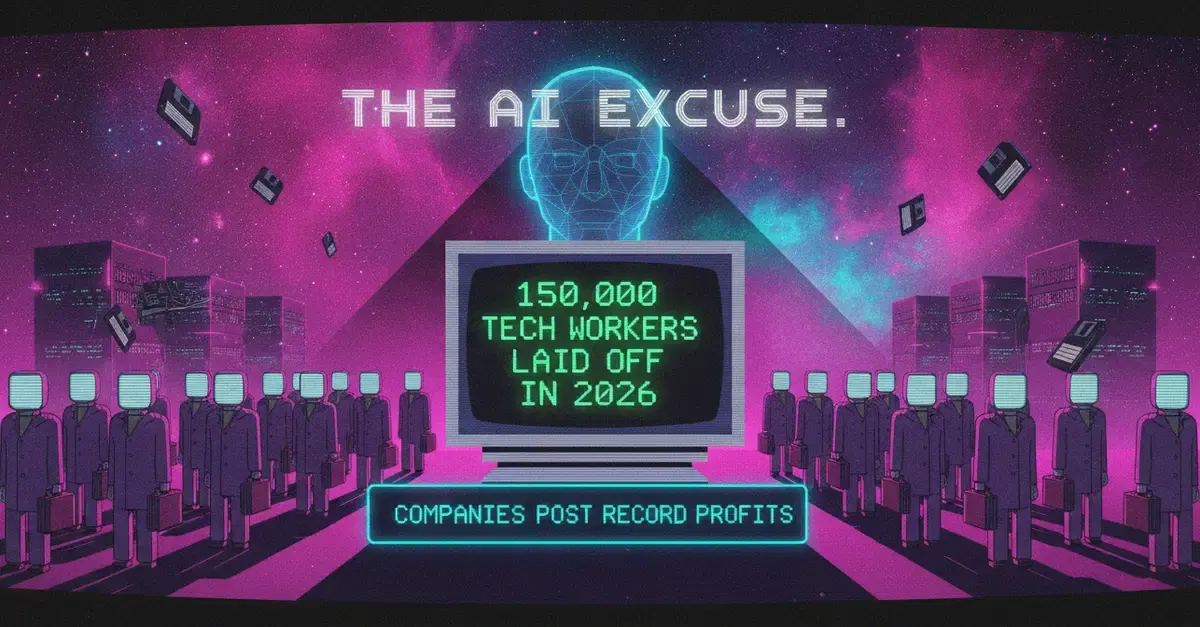
What's Happening: The 2026 Tech Layoff Wave, by the Numbers

As of mid-July 2026, the tech industry is in one of its most contradictory moments on record. TrueUp's live tracker has logged 450 layoff events at tech companies this year, with 166,090 people impacted, averaging 856 job losses per day. SkillSyncer's parallel tracker counts 267 distinct layoff events affecting 185,894 individuals, or roughly 963 cuts per day. More than 142,000 U.S. tech workers lost their jobs in the first five months of 2026 alone, a 33% increase over the same period in 2025, and the industry is on pace for a full-year total approaching 370,000, nearing the post-pandemic record of 430,000 set in 2023. Q1 2026 alone recorded 81,700 tech layoffs, the highest quarterly figure since early 2023. And according to outplacement firm Challenger, Gray & Christmas, tech is the only major industry where layoffs are actually increasing in 2026. Every other sector is cutting less than last year.
What This Means If You're Job Hunting in Tech Right Now

What makes 2026 different from every prior tech downturn is this: the companies executing the largest cuts are simultaneously reporting record revenues and committing hundreds of billions of dollars to expansion. This is not a financial crisis. It is a deliberate restructuring of the workforce, and that distinction matters enormously to anyone currently job hunting in tech.
When Cloudflare cut roughly 1,100 employees (about 20% of its workforce), it simultaneously reported quarterly revenue of $639.8 million, up 34% year-over-year and the highest single quarter in company history. CEO Matthew Prince stated plainly that "the vast majority of those we laid off were measurers," naming middle management, finance, legal, internal auditing, and revenue recognition. That sentence is a roadmap. It tells you which roles are being eliminated and, by implication, which roles are being protected and created. If you are a displaced tech worker right now, understanding why you were cut is not just therapeutic. It is strategic intelligence.
Key Numbers & Facts at a Glance
- 166,090+ tech workers impacted by layoffs as of mid-July 2026, per TrueUp
- 33% increase in U.S. tech layoffs year-over-year through May 2026 (TrueUp / Challenger, Gray & Christmas)
- 56% of layoff announcements (150 out of 267 events) explicitly cite AI, automation, or machine learning as a contributing factor, impacting approximately 156,270 workers
- 25-26% of all job cuts in March and April 2026 were attributed to AI, per Challenger, Gray & Christmas. AI is now an officially tracked layoff cause.
- $700 billion in combined 2026 capital expenditure commitments from Amazon, Microsoft, Alphabet, and Meta, nearly double 2025 levels, directed almost entirely at AI infrastructure
- Alphabet reported Q1 2026 net income up 81%; Meta posted Q1 net income of $26.77 billion; Amazon reported Q1 net sales of $181.5 billion
- Block (Jack Dorsey's company) cut nearly half its workforce, 4,000 jobs, the same day its stock rose 24%, on gross profit of $2.87 billion (up 24%)
"AI was the most-cited reason for tech layoffs in May 2026, and tech is the only major industry where layoffs are going up this year.", Challenger, Gray & Christmas
Which Workers and Job Seekers Feel This First
Not all tech roles are equally at risk. The pattern across 2026's biggest cuts is remarkably consistent:
- Middle management and "measuring" roles such as program managers, internal auditors, revenue recognition specialists, and finance leads are being cut at a disproportionate rate. Cloudflare's CEO named them explicitly.
- Non-technical support functions inside tech companies, including legal ops, HR generalists, content moderation, and vendor management, are being automated or consolidated.
- Gaming and entertainment divisions: Microsoft cut 1,600 Xbox roles and plans to eliminate nearly 20% of the Xbox division (3,200 total) by fiscal year-end.
- Legacy enterprise software roles: Oracle laid off up to 30,000 employees (roughly 18% of its global workforce) on March 31, 2026, to fund AI data center construction. The company had 141,000 full-time employees as of May 31, down from 162,000 a year ago.
- Intuit eliminated approximately 3,000 roles (17% of its workforce) specifically to reallocate resources toward AI product development.
- Cisco cut 4,000 roles (5% of workforce) in May, even as it reported record revenue of $15.8 billion, a 12% year-over-year increase.
If your role involves measuring, reporting, approving, or coordinating work that AI can increasingly track or generate, you are in the highest-risk category regardless of seniority or tenure.
What Employers and Recruiters Are Doing Right Now
The hiring behavior emerging from this wave is not a freeze. It is a hard pivot. Companies are cutting broad and hiring narrow. Amazon has pledged $200 billion in 2026 capex. Microsoft sits at approximately $190 billion. Alphabet revised its 2026 capital expenditure guidance to $175-190 billion after Google Cloud's backlog nearly doubled sequentially to $462 billion in Q1. Meta raised its capex guidance to $125-145 billion. All of that money has to be built, operated, maintained, and programmed by humans, at least for now.
Recruiters at major tech firms and their infrastructure suppliers are actively hiring for:
- AI/ML engineers and AI product managers, the single hottest category in 2026
- Data center technicians, electrical engineers, and network infrastructure specialists
- Cloud architects and platform engineers (especially AWS, Azure, and Google Cloud certified)
- Cybersecurity professionals, because AI-driven infrastructure creates massive new attack surfaces
- Technical program managers with AI or infrastructure experience (a narrower, safer version of the PM role being cut elsewhere)
Recruiters also report candidate pools that are far larger than normal, which gives employers more leverage on compensation and room for longer interview processes. Expect 4-6 rounds and slower offers even for in-demand roles.
What You Should Do This Week
The window between being laid off and updating your positioning matters more than most displaced workers realize. Six concrete actions you can take immediately:
Audit your resume for "measuring" language. If your bullet points are full of "managed," "coordinated," "oversaw," or "reported on," rewrite them around outcomes and technical output. Quantify impact in revenue, uptime, error reduction, or deployment speed, language that describes work harder to automate.
Get AI-certified this month, not next quarter. Google, Microsoft, and AWS all offer foundational AI and cloud certifications completable in 4-8 weeks. Given that 56% of layoff events explicitly cite AI as a factor, the fastest signal you can send a hiring manager is demonstrated AI literacy. Google's Cloud Digital Leader and AWS's AI Practitioner certifications are the quickest paths.
Target the $700 billion capex supply chain. The AI infrastructure buildout needs people at every layer. Companies like Equinix, Digital Realty, Vertiv, Arista Networks, and AMD are expanding aggressively. Search for roles at hyperscaler suppliers, not just hyperscalers themselves. The competition for jobs is lower and the growth trajectory is identical.
Separate your job search by company type. Publicly traded tech giants cutting for efficiency are not the same as AI-native startups scaling from Series B to Series C. Build two separate target lists: legacy tech companies where your transferable skills apply, and AI-native companies where your domain expertise in finance, legal, health, or logistics is the value, not the job title.
File for unemployment benefits the same week you're laid off, not when you feel ready. Many states have a one-week waiting period before benefits begin. Every week you delay is a week of benefits forfeited. This is not a contingency plan. It is a financial runway that gives you the leverage to be selective.
Document your AI usage and quantify it. Cloudflare's internal AI usage increased 600% in three months. If you have used AI tools to improve your output, reduce cycle time, or cut error rates, even informally, turn that into a resume bullet now. Hiring managers at surviving and growing tech companies are screening for employees who extend AI rather than compete with it.
What to Watch Next
The Challenger, Gray & Christmas monthly job cuts report for July 2026 will publish in early August and will be the first data point confirming whether the May peak was a temporary spike or the start of a second wave. Watch Oracle's Q1 fiscal 2027 earnings call (likely late August) for any commentary on whether its 30,000-person reduction has completed or whether further restructuring is planned. Oracle's moves have historically signaled broader enterprise software sector behavior. Finally, monitor the U.S. Bureau of Labor Statistics JOLTS (Job Openings and Labor Turnover Survey) report for June 2026, due mid-August. If AI-related job postings in the "Information" sector keep growing while overall tech openings contract, that confirms the split between AI-adjacent and AI-threatened roles is widening, and your job search strategy should reflect that immediately.
Editor's Picks
News AI Layoffs 2026: Record Profits, Pink Slips & Jobs That Survive
Jul 20, 2026
 Industries
 AI & ML Engineer Jobs 2026: Salaries, Skills & How to Break In
Jul 20, 2026
 Skills
 AI Skills Non-Tech Workers Actually Need to Get Hired in 2026
Jul 20, 2026
 Job Search
 Hidden Job Market 2026: Land Roles Never Posted Online
Jul 20, 2026