Resume Gaps in 2026: Honest Ways to Explain Them & Get Hired
Resume gaps are now the norm in 2026. Learn honest, ATS-friendly strategies to explain any employment gap and get hired faster with templates and examples.
Resume gaps in 2026: honest ways to explain them & get hired
You finished a job application, felt good about your resume, then froze at the six-month gap staring back at you from 2023. Should you bury it? Explain it in the cover letter? Leave it alone and hope no one notices? If that's you, here's the first thing worth knowing: the average resume a hiring manager reviews in 2026 includes at least one gap of three months or longer. Recruiters know gaps happen. What they don't know, and what they're quietly worried about, is why yours is there and whether you can still do the job. That's the problem this article solves.
The standard advice ("just be honest!") is technically correct but practically useless. Honesty without strategy leaves a hiring manager filling in blanks with their worst assumptions. This guide gives you a repeatable framework to address any type of gap (caregiving, layoff, burnout, health, travel, or plain old bad timing) in a way that's truthful, confident, and positioned to move you forward.
Why resume gaps are misunderstood in 2026's hiring landscape

The stigma around gaps is fading faster than most job seekers realize. A 2025 LinkedIn Workforce Confidence survey found that 76% of hiring managers say employment gaps are less of a concern than they were five years ago, and a separate MyPerfectResume survey found that 95% of employers reported being more understanding about employment gaps in 2025. SHRM research reinforces this: 72% of recruiters now view career breaks neutrally or positively when candidates explain them clearly.
But "more understanding" doesn't mean "don't worry about it." Roughly 30 to 38% of employers still view large, unexplained gaps negatively. The key phrase in all of that data is when candidates explain them clearly. Research tracking what hiring managers actually worry about when they see a gap breaks down like this: reliability (29%), motivation (27%), retention risk (24%), and skill atrophy (19%). A gap itself is not a red flag. An unexplained gap is, because it lets the hiring manager's imagination do the work.
The other structural shift that works in your favor: 85% of employers are now using skills-based hiring (up from 81% in 2024, per the TestGorilla State of Skills-Based Hiring 2025 report), and 53% have eliminated degree requirements entirely. When the dominant hiring philosophy centers on what you can do rather than when you were employed, a gap in your timeline matters far less than your ability to demonstrate relevant skills.
The core rule: frame the gap, then pivot to value
Before any tactical steps, internalize this principle: your job is not to apologize for the gap. It's to make the gap irrelevant by the end of the sentence. A two-part structure works for virtually every gap type:
[Honest one-line reason] + [What you did or maintained during the break] + [Why you're ready now]
This structure does three things at once. It answers the reliability concern (you have a real reason). It neutralizes the skill-atrophy concern (you stayed active or are demonstrably current). And it signals motivation by showing you're not just job-hunting because time ran out; you're job-hunting because you're ready. Every strategy below builds on this frame.
Step-by-step: how to address any resume gap
Step 1: categorize your gap before you write a word
Different gaps carry different levels of employer acceptance, and your strategy should match the type. Use this table as your starting point:
| Gap type | Employer acceptance rate | Primary concern to address |
|---|---|---|
| Medical leave | 75% | Current fitness for role |
| Caregiving | 69% | Return commitment, availability |
| Layoff / Redundancy | ~95% (near zero stigma) | Skill currency, job search activity |
| Education / Upskilling | ~85% | Relevance of what you studied |
| Burnout / Mental health | 40% | Stability, readiness |
| Travel / Personal | ~55% | Motivation, relevance |
Knowing your gap type tells you which concern to preemptively address. Not whether to disclose, but how to frame the disclosure.
Step 2: add a "Career Break" entry to your resume timeline
The single most effective ATS-friendly fix is to treat the gap as a resume entry rather than an absence. ATS systems evaluate skills relevance and keyword alignment. A formatted Career Break entry lets you include keywords (certifications completed, skills maintained, volunteer work) that an empty date range cannot.
Format:
Career Break | [Month Year], [Month Year]
[One-line reason] | [Relevant activity during break]
• Completed [certification/course] in [relevant skill]
• Maintained [relevant skill] through [volunteer work / freelance / consulting]
Example (caregiving gap):
Career Break, Primary Caregiver | March 2024, January 2026
Full-time caregiver for a family member following a medical diagnosis.
• Completed Google Project Management Certificate (Coursera, 2025)
• Maintained industry network through monthly PMI chapter meetings
You don't need to fill every gap with coursework. If you genuinely took time away, say so simply. The entry itself signals self-awareness and confidence.
Step 3: calibrate how much detail to include based on gap length
Not every gap needs the same treatment. Apply this decision rule:
- Under 3 months: Use a functional date format (year-only) to de-emphasize it entirely. "2023 to 2024" reads more cleanly than "March 2023 to November 2023." Most ATS systems and human readers won't flag a sub-quarter gap.
- 3 to 6 months: Add a one-line Career Break entry. No elaboration needed on the resume itself; prepare a two-sentence verbal answer for the interview.
- 6 to 12 months: Full Career Break entry with at least one activity bullet. Flag what you did to stay current.
- 12+ months: Career Break entry plus a brief LinkedIn "Career Break" tag (LinkedIn added this feature natively) and a two-to-three sentence cover letter mention. Address the gap proactively rather than hoping it goes unnoticed.
Step 4: write your gap explanation using the three-part formula
Fill in this template for your specific situation:
"I took [X months] away from full-time work to [honest reason]. During that time, I [specific activity: course, freelance project, caregiving, health recovery]. I'm now [signal of readiness: energized / fully recovered / finished with that commitment] and focused on [specific type of role you're targeting]."
Before (vague, passive):
"I had some personal issues and wasn't working for a while, but I'm ready to get back now."
After (specific, confident):
"I took eight months away to serve as the primary caregiver for my mother following her stroke diagnosis. During that time, I completed an AWS Cloud Practitioner certification and contributed to two open-source projects to stay technically current. She's now in long-term care, and I'm fully committed to returning to a senior cloud engineering role."
The "After" version addresses skill atrophy, signals motivation, and removes every ambiguity without over-explaining or over-apologizing.
Step 5: use the "recently laid off" data point if it applies to you
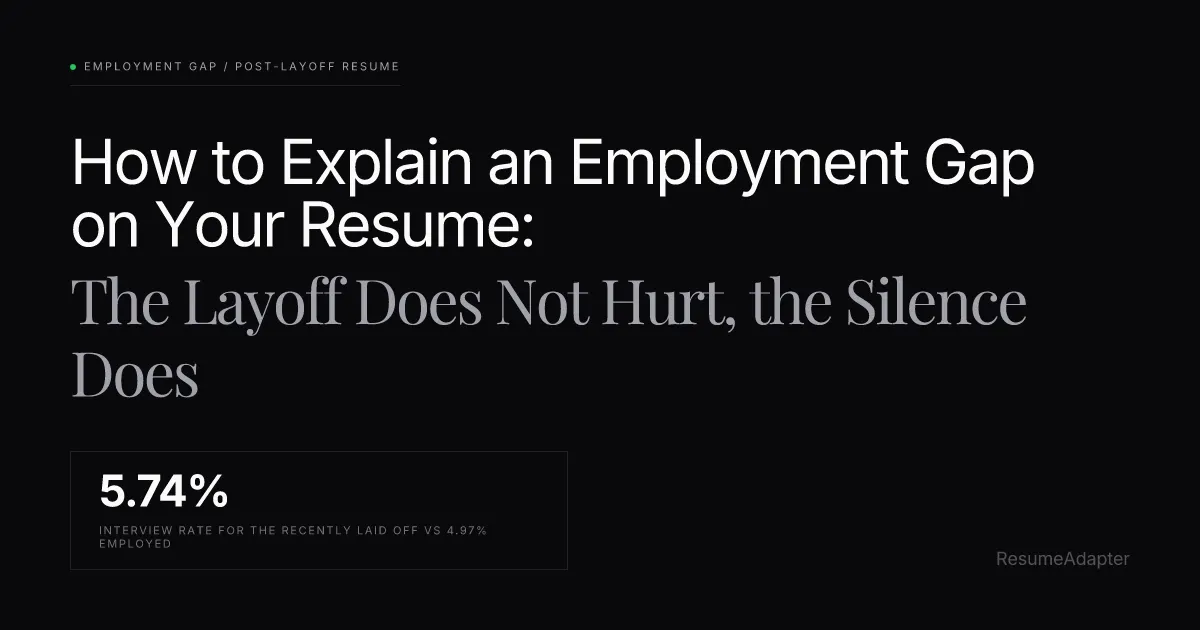
If your gap comes from a recent layoff, stop treating it like a liability. Huntr's Q1 2026 Job Search Trends Report (drawn from 58,814 real applications) found that job seekers laid off within the previous three months interviewed at a 5.74% rate, higher than currently employed candidates at 4.97%. The reason is simple: you're available immediately, you're motivated, and you're not in the middle of a counter-offer negotiation. Recruiters filling urgent openings know this.
More context: 32% of job seekers with a gap cite a layoff as the cause, which means a recruiter reading your resume already assumes a layoff before they assume a performance issue. State it plainly. "Impacted by a company-wide reduction in force (March 2026)" in a Career Break entry takes 10 seconds to read and removes all ambiguity.
Step 6: treat the 6-month mark as your action trigger
The Huntr data shows that interview rates decline gradually after a layoff, only becoming meaningfully lower past the six-month mark. Six months is your trigger date, not your crisis point. If you're approaching it, add structure to your resume:
- Add one completed certification (Google, Coursera, LinkedIn Learning, AWS, HubSpot: all free or low-cost)
- List one freelance, contract, or consulting engagement, even informal
- Add a volunteer role if it involves relevant skills
- Start a LinkedIn "Open to Work" Career Break entry
These aren't resume padding. They're honest signals of continued professional engagement.
Step 7: prepare your verbal answer before the interview, not during it
Your resume entry handles the ATS and the initial screen. But you'll be asked about the gap in the interview, and a stumbling, over-long answer does more damage than the gap itself. Prepare a 30-second scripted answer using the three-part formula from Step 4 and practice it aloud until it sounds natural, not rehearsed. The goal is confident brevity, not a confessional.
How this changes for different situations
Recent graduates and early-career candidates
If you graduated in 2024 or 2025 and haven't landed a full-time role yet, don't leave the date range empty. It reads as avoidance. Instead, create a Career Break or "Job Search / Professional Development" entry and list any relevant activity: part-time work, internships, freelance projects, online certifications, or relevant volunteer roles. Frame the gap as a transition period, not a failure.
Career changers
A career change gap is one of the most explainable, and often most compelling, types. If you left one field to retrain for another, lead with the outcome, not the departure: "I transitioned from retail management into UX design, completing a Google UX Design Certificate and building a portfolio of three end-to-end case studies." The gap becomes evidence of intentionality.
Mid-career professionals with multiple gaps
If your career history includes more than one gap, don't try to explain each one individually. That draws more attention, not less. Instead, use a hybrid resume format (skills and achievements summary at the top, followed by chronological work history) so the reader's first impression is your competency profile, not your timeline. Address gaps briefly in a "Career Notes" section or cover letter, and let your work history speak once the reader is already engaged.
Caregivers and those returning after health-related breaks
These gaps carry the highest social acceptance rates (caregiving: 69%, medical: 75%) but often feel the most personal to disclose. You are not required to share medical details. "I took 14 months away to manage a family health matter" is complete and sufficient. What you should include is evidence that you stayed professionally engaged in some capacity. Or, if you didn't, a clear signal that you're current now: a recent certification, a brief contract role, an industry event attended.
Mistakes that turn gaps into red flags
- Leaving the gap entirely unexplained. A blank date range on a resume invites the hiring manager's worst interpretation. A one-line entry costs you nothing and removes ambiguity.
- Over-explaining on the resume itself. The resume is not the place for a paragraph-long personal story. One line plus one bullet is the limit; save the full context for the cover letter or interview.
- Using year-only dates to hide a gap when it creates a bigger one. If you write "2022 to 2024" for a job that ended in January 2022, and your next job started in November 2024, you've created a 34-month gap instead of masking a 6-month one. Use month-year formatting consistently.
- Apologizing for the gap in your cover letter opening. Don't lead with "Despite my employment gap..." It signals insecurity before the reader has evaluated anything. Mention the gap briefly in the body, frame it in one sentence, and move on.
- Inflating activities during the gap. "Independent consulting" with no clients, projects, or output is easily seen through at the interview stage. If you didn't freelance, don't say you did. A clean, honest Career Break entry is more credible than a vague inflated one.
- Waiting until the interview to address a 12+ month gap. A gap of a year or more that appears nowhere on your resume or cover letter feels like concealment, even if it wasn't. Proactive disclosure reads as confidence; reactive disclosure reads as defensiveness.
Ready-to-use gap entry templates
Copy and adapt the relevant template directly into your resume.
Template A: layoff / redundancy
Career Break | [Month Year], Present
Impacted by company-wide reduction in force ([Month Year]).
• Completed [Certification Name] ([Platform], [Year])
• Actively interviewing for [target role type] roles in [industry/location]
Template B: caregiving
Career Break, Family Caregiver | [Month Year], [Month Year]
Full-time caregiver for [family member] during [brief context, e.g., "serious illness"].
• Completed [course/certification] to maintain professional currency
• [Optional: volunteer work or industry activity]
Template C: health / medical
Career Break, Medical Leave | [Month Year], [Month Year]
Personal health matter, now fully resolved.
• [Any relevant professional activity during recovery, if applicable]
Template D: career transition / retraining
Career Break, Professional Retraining | [Month Year], [Month Year]
Intentional transition from [Field A] to [Field B].
• Completed [Certification/Program Name]
• Built [portfolio / project / relevant output]
✅ Pre-application gap checklist
Before you submit your next application, confirm:
- Every gap of 3+ months has a named Career Break entry on my resume
- My Career Break entry uses the [reason] + [activity] + [readiness] structure
- I'm not using year-only dates in a way that accidentally creates a larger gap
- My cover letter mentions the gap in one sentence (for 6+ month gaps) without leading with it
- I have a practiced 30-second verbal answer ready for the interview
- I've confirmed my LinkedIn profile includes a Career Break entry or "Open to Work" status
- Any certifications, courses, or projects completed during the break are listed on both my resume and LinkedIn
Frequently asked questions
Do I have to explain a resume gap on my resume itself, or can I save it for the interview? For gaps under three months, no explanation is needed on the resume. Use year-only dating if it helps. For gaps of three to six months, a one-line Career Break entry is sufficient. For gaps of six months or more, address it briefly on the resume and prepare a fuller answer for the interview. Waiting until the interview to explain a long gap reads as avoidance and puts you on the defensive before you've had a chance to impress.
Will an ATS system automatically reject me because of a gap? Most modern ATS platforms (including Workday, Greenhouse, and Lever) do not automatically disqualify candidates for employment gaps. They parse skills, keywords, and experience relevance. An ATS can flag an unexplained date gap as an anomaly, which is why adding a Career Break entry with relevant keywords (certifications, skills maintained) is more effective than leaving dates blank.
How far back do I need to explain gaps on my resume? As a general rule, only address gaps that fall within the past 10 years of your work history, which is typically the window you include on a resume. Gaps older than a decade are rarely relevant to a hiring decision and don't need to appear on your resume at all. Focus your explanation energy on anything in the last five years.
What if I was fired (not laid off) and that's why there's a gap? Don't lie, but don't over-disclose on your resume either. A Career Break entry that reads "Departed [Company] in [Month Year]" without elaboration is honest. Prepare a brief, unapologetic explanation for the interview: acknowledge what happened, describe what you learned, and pivot to why you're a strong candidate now. Interviewers respect self-awareness and forward momentum far more than a polished cover story.
Is a one-year gap too long to recover from in 2026? No. Analysis of 27 million resumes shows that in 2025, 1 in 4 job seekers had a gap of at least 12 months, so hiring managers are accustomed to seeing them. The key actions for a 12+ month gap are: add a structured Career Break entry, include at least one concrete professional activity (certification, freelance, volunteer), address it briefly in your cover letter, and walk into your interview with a confident, practiced answer. The gap is not disqualifying. The absence of a clear, credible explanation is.
Editor's Picks
 News
News AI Layoffs 2026: Record Profits, Pink Slips & Jobs That Survive
Jul 20, 2026
 Industries
 AI & ML Engineer Jobs 2026: Salaries, Skills & How to Break In
Jul 20, 2026
 Skills
 AI Skills Non-Tech Workers Actually Need to Get Hired in 2026
Jul 20, 2026
 Job Search
 Hidden Job Market 2026: Land Roles Never Posted Online
Jul 20, 2026