AI Layoffs 2026: Record Profits, Pink Slips & Jobs That Survive
150,000 tech workers cut in 2026 as AI replaces roles at record-profitable firms. Here's who's most at risk, who's hiring, and what to do right now.
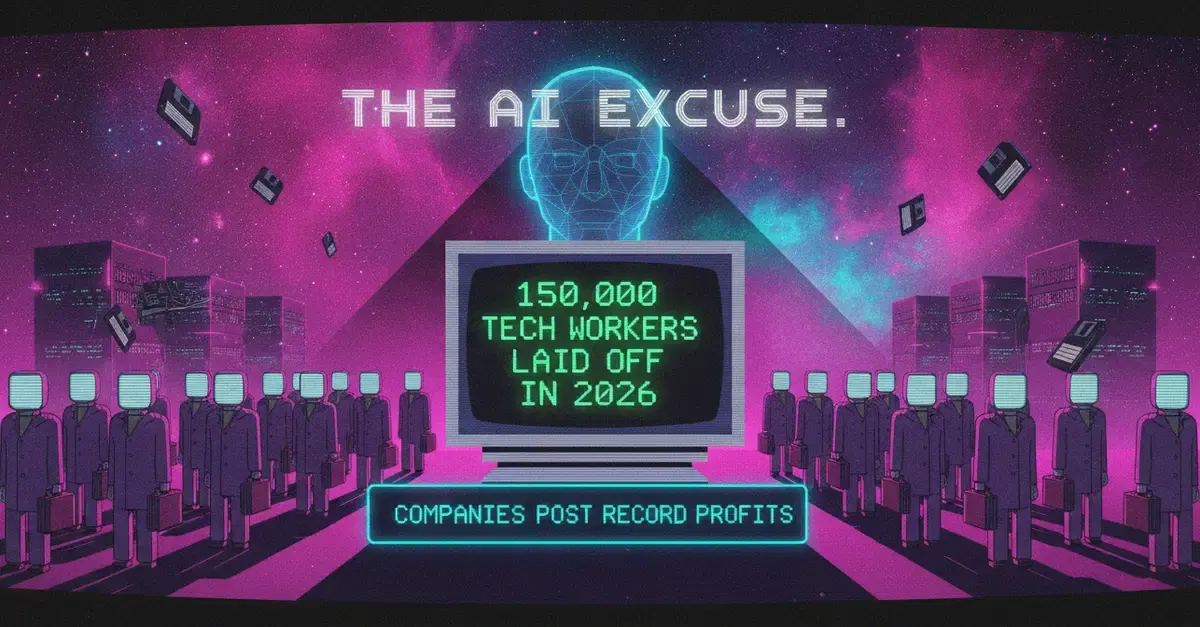
What's happening: tech's biggest layoff wave of 2026

In the first half of 2026, an estimated 363 layoff events have swept through the technology sector, affecting nearly 150,000 workers at a pace of roughly 974 job losses every single day, according to TrueUp, the tech job board and recruiting platform that runs one of the most widely cited tech layoff trackers. Outplacement firm Challenger, Gray & Christmas confirms the picture: tech companies announced 139,156 job cuts through June, an 83% surge compared to 76,214 cuts in the same period of 2025. That figure puts the industry on pace for a full-year total approaching 370,000, which would come dangerously close to the post-pandemic record of 430,000 set in 2023.
The names behind the pink slips are not struggling startups. They are Oracle, Meta, Microsoft, Google, Cisco, Intuit, and Block, some of the most profitable companies in corporate history, and they are explicitly tying the cuts to artificial intelligence.
What this means if you're job hunting in tech right now

This is not a normal cyclical downturn. The defining feature of 2026's layoff wave is its central contradiction: record profits and record headcount reductions happening at the same time. Oracle is responsible for 19.5% of all tech job cuts this year and acknowledged in its annual filing that AI deployment had directly replaced jobs. Meta cut roughly 8,000 employees while reporting Q1 2026 net income of $26.8 billion. Cloudflare eliminated 20% of its workforce on the same earnings call where it announced record quarterly revenue of $639.8 million. CEO Matthew Prince explicitly said it was not a cost-cutting exercise.
For job seekers, this reframes the entire search. You are not competing against a bad economy. You are competing against companies that are choosing to replace human roles with AI while hiring selectively for people who can build, manage, and optimize those AI systems. The question is not whether to worry. It is how to position yourself on the right side of that line.
Key numbers and facts at a glance
- 363 layoff events at tech firms tracked in 2026 so far, per TrueUp
- ~150,000 tech workers affected, a pace 44% faster than the equivalent period in 2025
- 83% increase in tech job cuts year-over-year through June (Challenger, Gray & Christmas)
- 54% of layoff events explicitly cite AI, automation, or machine learning as a contributing factor, affecting approximately 168,770 workers
- $700 billion in combined 2026 capital expenditure committed by Amazon, Microsoft, Alphabet, and Meta, nearly double 2025 levels, mostly directed at AI compute and data centers
- Tech accounts for nearly a third of all U.S. job cuts in H1 2026
- The largest single layoff of 2026: Oracle, 30,000 employees
"54% of 2026 layoff events explicitly cite AI, automation, or machine learning as a contributing factor, affecting approximately 168,770 workers."
Which workers and job seekers feel this first
The cuts are not random. They cluster around predictable role types and sectors:
- Mid-level operations and back-office roles: customer support, data entry, content moderation, and financial operations functions are the fastest to be automated. PayPal is cutting roughly 4,760 jobs; Citigroup is targeting 20,000 eliminations by year-end, with its outgoing CFO publicly linking headcount declines to AI tools.
- Cybersecurity analysts in large enterprises: Google quietly cut staff from its Cloud division, Threat Intelligence Group, and Mandiant-linked teams even as Cloud revenue grew 63% and exceeded $20 billion for the first time. Counterintuitively, entry-level cybersecurity roles at smaller firms remain in demand.
- Software engineers in non-AI product areas: GitLab laid off 14% of its staff, exited 22 countries, and is rebuilding its core infrastructure around AI. Microsoft's 4,800-person cut targets roles the company described as no longer matching its operating model.
- Middle management layers: GitLab explicitly cited "flattening management layers" as part of its restructuring. This is a common thread, because AI reduces coordination costs and makes managerial layers structurally redundant.
- Finance and accounting professionals at technology firms: Intuit eliminated roughly 3,000 roles (17% of its workforce), specifically describing the cuts as reducing "complexity" before reallocating toward AI product development.
What employers and recruiters are doing now
The hiring market in 2026 is splitting sharply. Companies are freezing generalist headcount while competing hard for AI-adjacent talent. Here is what employer behavior actually looks like right now:
- AI role creation runs parallel to cuts. Meta moved approximately 7,000 employees into new AI-focused roles even as it eliminated 8,000 others. The net workforce shrank, but the internal composition shifted dramatically.
- Infrastructure investment is creating downstream hiring. Amazon ($200B capex), Microsoft (roughly $190B), Alphabet ($175-190B), and Meta ($125-145B) are building data centers, networking infrastructure, and AI compute capacity at unprecedented scale. That requires construction, facilities, hardware, and cloud engineers, and none of those roles are being automated.
- AI labs and tooling companies are in hiring mode. While established tech giants trim headcount, newer AI-native companies are absorbing displaced talent. Recruiters at these firms are actively targeting laid-off engineers from Oracle, Cisco, and Intuit.
- Non-tech sectors with AI exposure are cautious but not cutting. Healthcare, legal tech, and logistics are integrating AI tools but have not followed tech's aggressive headcount reduction pattern yet.
What you should do this week
If you are currently employed or actively job searching in a field touched by this wave, these are the highest-leverage actions you can take right now:
Audit your role for AI substitutability. Honestly assess how much of your daily work involves pattern recognition, data retrieval, content generation, or rule-based decisions. Those tasks are the most exposed. Document the parts of your role that require judgment, relationships, or physical presence, and make those visible in your resume and interviews.
Add one AI tool to your workflow this week and put it on your resume. Employers are not just looking for AI engineers. They want people who use AI to multiply their output. Familiarity with tools like Copilot, Claude, Gemini, or domain-specific AI platforms signals adaptability. List them under a "Tools" section with context: not just the tool name, but what you did with it.
Target companies on the receiving end of AI infrastructure investment. Data center operators, cloud hardware suppliers, AI safety teams, and model evaluation firms are all in growth mode. Search LinkedIn and TrueUp's job board filtered by companies with active AI capex announcements.
Update your LinkedIn headline to reflect AI fluency. Recruiters are running searches that filter for AI-adjacent keywords. If your headline still reads "Senior Analyst" or "Operations Manager," you are invisible to the searches that matter right now. Add a phrase like "AI-augmented" or "AI workflow implementation" if it is genuinely accurate.
Network specifically with people who survived AI restructurings. People who kept their jobs through Oracle's 30,000-person cut or Meta's reorganization know exactly what protected them. Those conversations are more valuable than any job board in 2026.
Register for WARN Act and equivalent international early-warning databases. In the U.S., companies with 100 or more employees must file WARN notices 60 days before mass layoffs. Monitoring these filings gives you advance notice before layoffs are publicly announced and before the job market floods with displaced workers from the same company.
What to watch next
Three near-term developments will shape the second half of 2026. First, Citigroup's target of 20,000 AI-driven eliminations by year-end is the most significant potential financial-sector event on the calendar. If it accelerates, it signals that the AI displacement pattern has fully crossed from tech into banking. Second, Alphabet's next earnings report will confirm whether its Cloud backlog of $462 billion is converting to revenue, which will determine whether Google's quiet internal cuts deepen or stabilize. Third, watch for any legislative response. As of July 2026, no major U.S. legislation specifically governing AI-driven layoffs exists, but labor organizations are actively pushing for WARN Act amendments that would require AI displacement to be cited in filings. That policy shift, if it comes, would change how companies communicate these decisions and how much warning workers actually get.
Editor's Picks
 Industries
 AI & ML Engineer Jobs 2026: Salaries, Skills & How to Break In
Jul 20, 2026
 Skills
 AI Skills Non-Tech Workers Actually Need to Get Hired in 2026
Jul 20, 2026
 Job Search
 Hidden Job Market 2026: Land Roles Never Posted Online
Jul 20, 2026
 Resume
 One Page vs. Two Page Resume in 2026: What the Data Says
Jul 20, 2026