AI & ML Engineer Jobs 2026: Salaries, Skills & How to Break In
AI & ML engineer jobs in 2026: real salary data by experience and location, must-have skills, hiring trends, resume tips, and a clear action plan to break in.

The AI & ML Engineering Job Market in 2026

If there is one sector in tech where the numbers border on absurd, it is artificial intelligence and machine learning engineering. Right now, there are roughly 1.6 million open AI/ML positions worldwide and only about 518,000 qualified candidates to fill them, a demand-to-supply gap of 3.2 to 1. Job postings have grown nearly 143% year-over-year, and AI roles now account for 1.8% of all US job postings, up from just 0.7% a decade ago. Interview activity for AI engineers jumped 213% between September 2025 and June 2026 alone.
What makes this moment genuinely different from the broader tech market is the contrast. Software engineering postings are down roughly 70% from their February 2022 peak. Entry-level tech roles have dropped 34% since 2020. AI and ML engineering roles, by contrast, have more than doubled since mid-2024. The World Economic Forum projects an 82% increase in machine learning roles over the coming years as models embed themselves deeper into finance, healthcare, logistics, and manufacturing. The global ML market, valued at $55.8 billion in 2024, is on track to hit $282 billion by 2030 at a 30.4% compound annual growth rate.
The bottleneck, as one talent tracker put it bluntly, is qualified candidates, not open roles. That gap is your opportunity.
Most in-demand roles right now
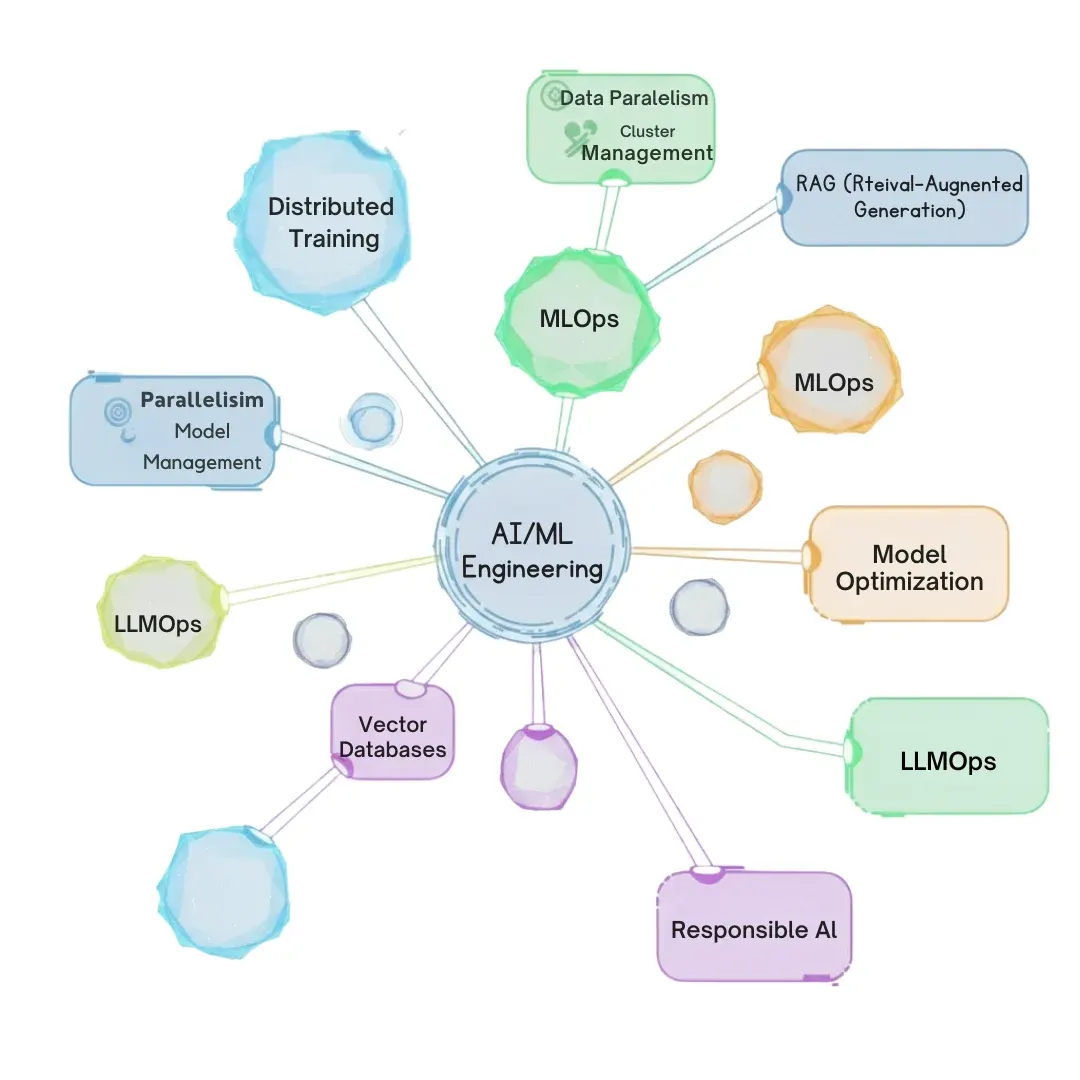
ML engineering postings average roughly 490 per week with no seasonal slowdown, and 70% of open roles are at the mid-level or senior individual contributor band. Here are the titles drawing the most hiring activity in 2026:
- Machine Learning Engineer, Builds, trains, and deploys ML models into production systems; the core title and highest-volume role in the field.
- AI/ML Platform Engineer, Designs the infrastructure (feature stores, model registries, serving layers) that other ML teams build on; demand is surging as orgs scale beyond individual models.
- MLOps Engineer, Owns model monitoring, retraining pipelines, CI/CD for ML, and reliability in production; effectively the DevOps specialist for AI systems.
- Applied AI Scientist, Bridges research and production, adapting state-of-the-art techniques for real business problems in areas like NLP, computer vision, and recommendation systems.
- LLM / Generative AI Engineer, Specialises in fine-tuning, retrieval-augmented generation (RAG), and productionising large language model applications; the fastest-growing sub-specialty of 2026.
- AI Data Engineer, Builds and maintains the high-quality data pipelines that training and evaluation depend on; demand has grown in tandem with model quality requirements.
- ML Research Scientist, Conducts novel research, often inside frontier labs or well-funded startups; typically requires a PhD and a strong publication record.
- Responsible AI / AI Safety Engineer, Ensures fairness, interpretability, and compliance in deployed models; a role expanding rapidly under EU AI Act and US AI governance pressure.
Realistic salary ranges in 2026
Compensation in AI/ML engineering is among the highest in all of tech, and the gap between experience bands is wider here than almost anywhere else.
| Experience Level | Typical Base Salary (US) | Total Comp (with Equity/Bonus) |
|---|---|---|
| Entry-level (0-1 yr) | $90,000 - $135,000 | $98,000 - $155,000 |
| Early-career (1-4 yrs) | $125,000 - $160,000 | $140,000 - $200,000 |
| Mid-level (4-7 yrs) | $155,000 - $210,000 | $200,000 - $300,000 |
| Senior (7+ yrs) | $175,000 - $310,000 | $280,000 - $500,000+ |
| Staff / Principal (FAANG+) | $250,000 - $400,000+ | $500,000 - $600,000+ |
Source aggregates: Glassdoor reports an average AI/ML Engineer salary of $178,969, with the 90th percentile at $268,481. Robert Half's 2026 benchmarks place the range at $134,000 to $193,250. PayScale puts the average ML engineer with AI skills at $134,241.
Location variance: San Francisco remains the top-paying market. Glassdoor's average there is $212,859, with Lead/Principal roles reaching $355,000 base. New York is a close second. The good news for remote workers: geographic pay-band discounting has largely faded. Senior fully remote AI/ML engineers now see a median around $206,600, competitive with all but the very top on-site markets.
The steepest salary jump is between mid-level and senior. Engineers with three to five years of genuine production ML experience are the scarcest talent segment, and their salaries grew 9.2% year-over-year in 2026, the largest increase of any experience band in tech. At frontier AI labs like OpenAI and Scale AI, total compensation for top AI roles can exceed $500,000. Most companies cannot match that, but most companies are also offering packages that would have been considered exceptional just three years ago.
Required qualifications and skills
Hard requirements: what employers are checking
- ✅ Degree: Bachelor's in Computer Science, Mathematics, Statistics, or a related quantitative field is the floor. About 65% of senior ML roles list a master's or PhD as preferred (not always required if your portfolio is strong).
- ✅ Python fluency is non-negotiable across virtually every job description.
- ✅ ML frameworks: PyTorch is the dominant framework in 2026 (preferred over TensorFlow in most new postings); JAX is growing at research-oriented shops.
- ✅ ML fundamentals: Supervised/unsupervised learning, gradient descent, model evaluation, regularisation. You must be able to discuss and implement these from scratch in interviews.
- ✅ Production deployment: Experience with model serving (FastAPI, TorchServe, Triton), containerisation (Docker, Kubernetes), and cloud ML services (AWS SageMaker, GCP Vertex AI, Azure ML).
- ✅ Data engineering basics: SQL, distributed data processing (Spark or Ray), familiarity with feature stores.
- ✅ LLM literacy: Prompt engineering, RAG architecture, fine-tuning (LoRA/QLoRA), and evaluation frameworks are now expected even in non-LLM-specialist roles.
- ✅ MLOps practices: Experiment tracking (MLflow, Weights & Biases), model monitoring, data drift detection.
- ✅ Certifications that matter: AWS Certified Machine Learning - Specialty, Google Professional Machine Learning Engineer, and the DeepLearning.AI / Coursera specialisations (particularly the Machine Learning Specialisation and MLOps Specialisation) all carry genuine employer recognition.
- ✅ Version control and software engineering discipline: ML engineers are expected to write clean, testable, reviewable code, not just notebooks.
What employers actually prioritise beyond the checklist
Technical depth matters, but the candidates who stand out in 2026 are the ones who can operate at the intersection of ML and business impact. Hiring managers consistently flag communication as a differentiator at the senior level. Specifically, the ability to explain model behaviour, tradeoffs, and limitations to non-technical stakeholders. Ownership mindset is equally prized: employers want engineers who track their models after deployment, respond to performance degradation, and think in terms of outcomes rather than experiments. Intellectual curiosity backed by evidence (a GitHub portfolio, a Kaggle track record, a technical blog, or conference contributions) signals that a candidate stays current in a field that rewrites itself every six months.
Hiring trends and forces reshaping the field in 2026
The AI/ML hiring market is not just growing. It is restructuring.
The production ML premium is real and widening. Companies that moved fast on AI in 2023 to 2024 are now sitting on models that are underperforming, drifting, or impossible to maintain. Engineers who have shipped ML systems that run reliably at scale (not just trained models in notebooks) are commanding disproportionate pay and getting the fastest offers.
LLM integration has become a baseline expectation, not a specialty. Twelve months ago, generative AI experience was a differentiator. In 2026, it is table stakes. Job descriptions across healthcare, finance, and logistics now assume familiarity with RAG pipelines, LLM evaluation, and responsible deployment of foundation models, even for roles that are not primarily LLM-focused.
The EU AI Act is creating a new hiring category. The regulatory environment is reshaping hiring, particularly for multinationals. Roles combining ML engineering with compliance, interpretability, and AI governance are among the fastest-growing in Europe and increasingly in US companies with European exposure. Engineers who understand model documentation, fairness auditing, and explainability tools (SHAP, LIME, Captum) are fielding entirely new categories of inbound recruiter interest.
On the remote work front: fully remote ML engineering roles remain widely available and well-compensated, though some frontier labs and hyperscalers have returned to hybrid mandates for senior hires. Contract and fractional AI roles with day rates of $800 to $1,200 for senior engineers have expanded significantly as companies test AI initiatives before committing to permanent headcount.
Resume and interview tips for AI/ML engineering roles
Lead with production impact, not model accuracy. Hiring managers see hundreds of resumes that say "trained a model achieving 94% accuracy." They want to know: did it ship? What did it change? Reframe bullet points as business outcomes. For example: "Reduced customer churn prediction latency by 60% by migrating inference from batch to real-time serving, enabling same-day intervention workflows."
Build a public portfolio that proves deployment experience. A GitHub repo of notebooks is no longer enough. Show end-to-end projects: data ingestion, feature engineering, model training, evaluation, serving, and monitoring. A working API endpoint or a Hugging Face Space demo carries more weight than a Jupyter notebook, even a polished one.
Match your resume keywords to the ML stack in the job description. ATS systems in tech are aggressive. If a role lists PyTorch, W&B, Kubernetes, and SageMaker and you have experience with all four, every one of those terms should appear in your resume. Don't leave it to inference.
Prepare for the system design interview, not just the coding interview. Most mid-to-senior ML engineering interviews now include an ML system design round. Practise designing end-to-end systems: recommendation engines, fraud detection pipelines, real-time NLP inference. Resources like the "Machine Learning System Design" framework are worth drilling before interviews.
Know your numbers. Interviewers expect you to quantify your previous models: training data volume, inference latency, model size, business metric movement. Vague answers ("we improved recommendations") are a red flag at the senior level. If your previous role restricted what you could share, frame it as orders of magnitude: "we processed hundreds of millions of events daily" still works.
Research the company's AI stack before the interview. Most AI-forward companies publish engineering blog posts, conference talks, or papers about their systems. Reading one before your interview and referencing it naturally ("I saw your team's post about your feature store migration") signals genuine interest and technical literacy in a way that generic enthusiasm never does.
Is this field right for you?
Use this quick-reference profile to self-qualify before committing to a pivot or upskilling investment.
| You're a strong fit if... | You may want to reconsider if... |
|---|---|
| You enjoy building systems end-to-end, not just experimenting | You prefer pure research with no production accountability |
| You're comfortable with mathematical foundations (linear algebra, calculus, probability) | Math at this level feels like a hard blocker rather than a learnable gap |
| You like staying current, because the field moves fast | You prefer stability and well-established best practices |
| You can write clean, reviewable Python code | You see coding as a means to an end rather than a craft |
| You're motivated by measurable, concrete impact on real users | You prefer open-ended theoretical work without clear success metrics |
| You're willing to invest 6-18 months in serious upskilling if switching careers | You need to be earning at senior levels within 3 months of switching |
Best-fit backgrounds for career changers: Software engineers (especially backend or data engineers) have the shortest ramp, typically 6 to 12 months of focused ML upskilling. Data scientists who want to move closer to production engineering are also natural fits. Mathematicians, statisticians, and physicists often have strong foundations but need to build software engineering discipline. Domain experts (such as clinicians entering health AI or traders entering fintech AI) can find fast entry points into applied AI roles in their own industries.
Next steps to break in or level up
Here is an ordered action plan, whether you are entering the field from scratch or pushing from mid-level to senior.
Audit your current stack against 2026 job descriptions. Pull 20 real ML engineering postings from LinkedIn, Wellfound, or Levels.fyi. List every skill that appears in at least 10 of them. That is your skill gap map. Work from that, not from a generic curriculum.
Complete a recognised ML certification as a credibility signal. The AWS Certified Machine Learning - Specialty and Google Professional Machine Learning Engineer certifications are the two most consistently cited in job descriptions. DeepLearning.AI's MLOps Specialisation on Coursera is widely respected for production-focused roles. These won't replace experience, but they validate fundamentals and show up in ATS keyword matching.
Build and ship one end-to-end production-grade project. Pick a real problem, build a complete pipeline, deploy it as a live API or interactive demo, and write a technical post-mortem about what you built and what you'd do differently. This single artefact will do more for your applications than a dozen notebook tutorials.
Contribute to open-source ML projects. Even small, well-documented contributions to projects on GitHub (bug fixes, documentation improvements, test coverage) establish a public track record and get your name in front of the engineers who maintain tools that hiring companies use.
Get active in the communities where ML engineers actually spend time. Hugging Face forums, ML Twitter/X, the MLOps Community Slack, Papers with Code, and local ML meetups are where referrals happen. A referral in AI engineering is worth 10 cold applications because the hiring bottleneck is talent identification, not budget.
Negotiate on total compensation, not just base salary. In a market where demand outstrips supply 3.2 to 1, you have real leverage. Get offers in writing before negotiating. Use Levels.fyi to benchmark total compensation (base + equity + bonus) for your experience level and location. Never negotiate on base salary alone. Equity refresh schedules and signing bonuses are often more movable than base in tech hiring.
The AI and ML engineering market in 2026 is as close to a genuine job seeker's market as tech has produced in years. The gap is real, the pay is exceptional, and the demand shows no sign of softening. The candidates who win are the ones who show up with production experience, a public portfolio, and the ability to communicate impact, not just model metrics.
Editor's Picks
 News
News AI Layoffs 2026: Record Profits, Pink Slips & Jobs That Survive
Jul 20, 2026
 Skills
 AI Skills Non-Tech Workers Actually Need to Get Hired in 2026
Jul 20, 2026
 Job Search
 Hidden Job Market 2026: Land Roles Never Posted Online
Jul 20, 2026
 Resume
 One Page vs. Two Page Resume in 2026: What the Data Says
Jul 20, 2026